Overview
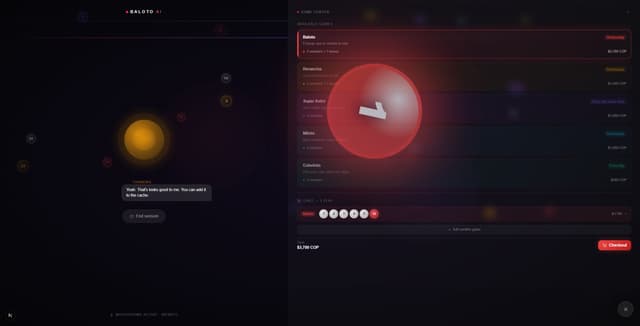
The Baloto Visual Agent is an AI-powered assistant designed to help users navigate and interact with an online lottery platform through an intuitive visual interface.
Rather than relying solely on traditional forms and menus, the system introduces a conversational assistant capable of guiding users through lottery games, ticket selection, and platform features.
The project explores how AI agents can simplify complex user interfaces and create a more intuitive interaction model for transactional web applications.
The Problem
Lottery platforms often require users to navigate multiple steps when selecting games, generating numbers, and managing entries.
These processes typically involve:
- navigating multiple pages
- understanding complex rules
- manually selecting numbers
- managing cart selections
For new users, this can create friction and confusion.
The goal of this project was to explore how an AI-driven assistant could reduce cognitive load by guiding users through the process.
My Role
I designed and implemented the complete system, including:
- AI agent behavior and system prompts
- UX design for the visual assistant interface
- interaction logic between the assistant and the website
- conversational flows for lottery selection
- integration between the agent and platform actions
The project required balancing natural conversational interaction with deterministic system actions such as adding tickets to a cart.
Approach
The visual agent acts as an intelligent interface layer between the user and the platform.
Instead of manually navigating through menus, users can interact with the agent by asking questions such as:
- "How do I play this game?"
- "Add a Baloto ticket"
- "Generate numbers for me"
- "What games can I play?"
The agent interprets the user's intent and triggers the appropriate platform actions.
This interaction model aims to make the experience feel more like speaking to a knowledgeable assistant rather than navigating a website.
Implementation
The system combines:
- AI-driven conversational understanding
- structured tool calling for platform actions
- interface components that visually represent the agent
The architecture separates:
- user interaction layer
- AI reasoning layer
- platform action layer
This ensures that the AI can guide users conversationally while maintaining reliable control over deterministic actions such as cart updates.
Challenges
One of the major challenges involved ensuring that the AI assistant triggered the correct platform functions.
AI models can sometimes attempt to calculate or reason about actions instead of calling the appropriate system tools.
To address this, the agent was configured with structured instructions to ensure it relied on deterministic functions for tasks such as price calculation and cart management.
This hybrid architecture helps maintain both conversational flexibility and operational accuracy.
Outcome
The Baloto Visual Agent demonstrates how AI assistants can transform traditional website navigation into an interactive guided experience.
The project highlights how conversational interfaces can:
- simplify complex workflows
- reduce friction in transactional platforms
- make digital services more accessible to new users
It also serves as a proof-of-concept for integrating AI agents into web applications as an intelligent UX layer.